AI Visibility
Track your AI visibility in ChatGPT and Gemini
Longwave AI Visibility checks whether ChatGPT and Gemini name your product when buyers ask for recommendations. It tracks your mentions and rankings alongside your competitors. Set up the AI rank tracker in ChatGPT, Codex or Longwave and choose when it runs.
An AI rank tracker you run from the chat
Tag the plugin in ChatGPT or Codex and share your product's name or website. The agent reads your website and suggests buyer questions, competitors and a country for the check. Ask the agent to change any questions or choose a different country.
Approve the plan and choose a schedule. Longwave saves your setup and repeats the check as often as weekly.
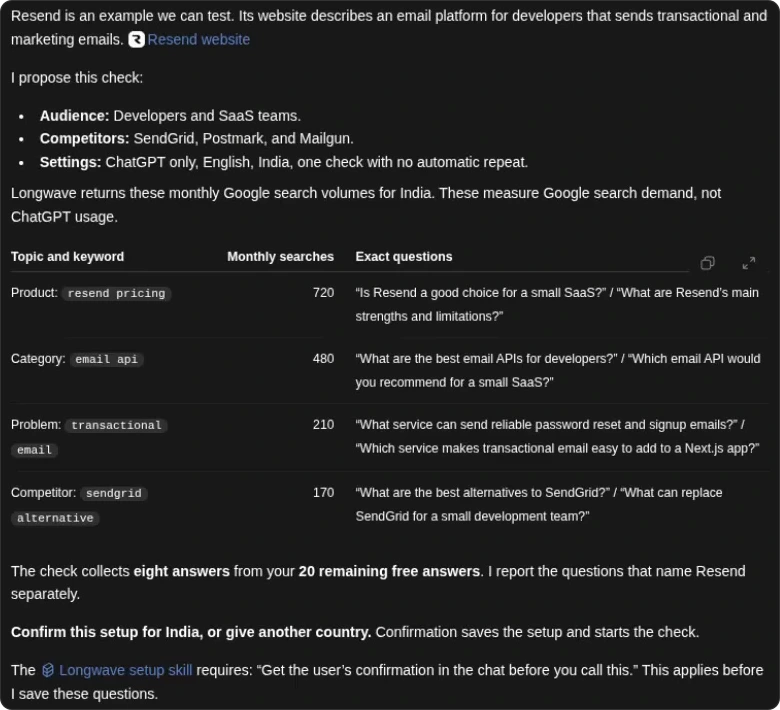
AI visibility tracking built on buyer questions
The agent groups buyer questions by topic. For an email API, the questions might include "What are the best email APIs for developers?" and "What can replace SendGrid for a small development team?"
Longwave reports questions that name your product separately. Your visibility score only uses questions that do not name your product. This shows whether the assistant mentions your product without a direct request.
Each topic includes its monthly Google search volume and a twelve-month trend. Use these numbers to see which topics people search for most. Checks run in signed-out sessions with web search turned off.
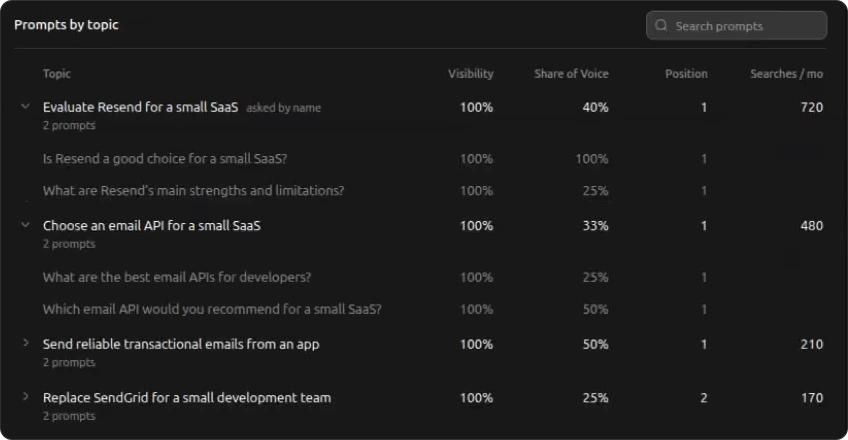
See your AI share of voice against competitors
Longwave records which brands each answer names. If the answer lists recommendations, Longwave also records your product's position.
The results show three measures:
- Visibility: the percentage of answers that name your product.
- Average position: your product's average place in recommendation lists.
- AI share of voice: your product's share of all brand mentions in the answers.
View these results by topic or assistant. After the second check, you can compare the results over time.
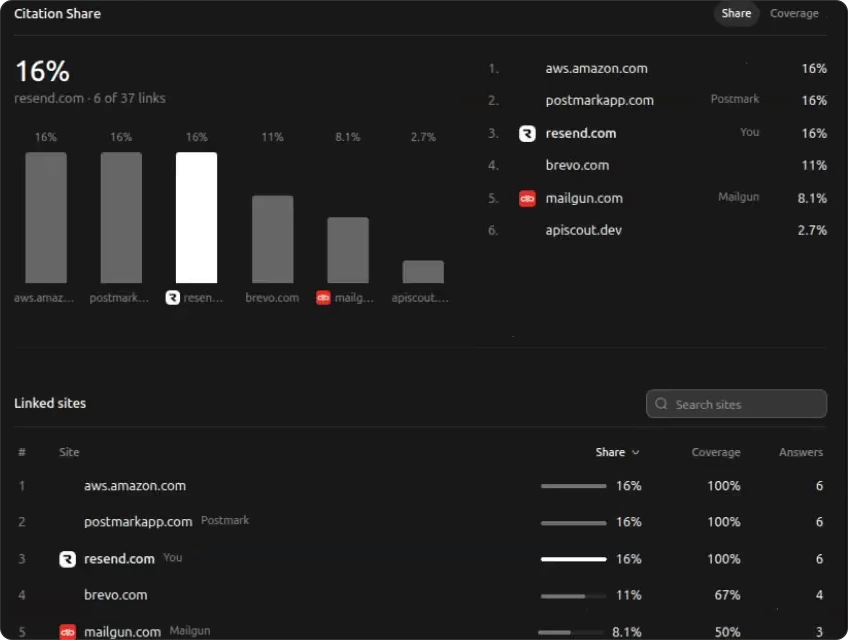
AI brand mentions and the pages AI cites
Longwave saves each question, its answer and any links in the answer. These links are called citations. You can see whether ChatGPT or Gemini cites your website or app.
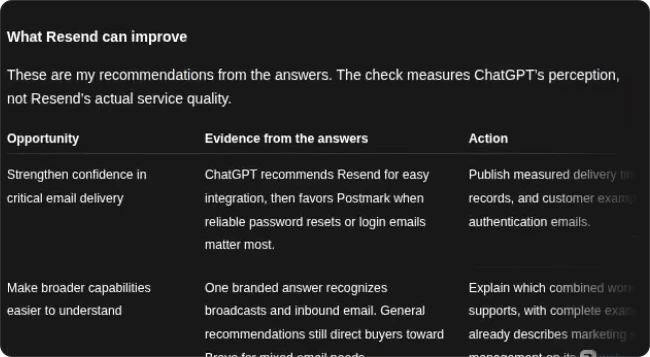
If an assistant repeatedly cites a review or comparison page, check whether that page includes your product. Your agent can read the saved answers and citations when you ask for an analysis.
Turn the results into an AI visibility audit
Ask ChatGPT or Codex, "Which answers mention competitors but leave out my product? What can I improve?" The agent reviews the saved answers and writes an AI visibility audit. The audit shows where your product appears and suggests changes to your website or content.
Ask an agent in Longwave to make the changes. Use the next scheduled check to see whether your visibility changes.
A worked example: Resend vs SendGrid, Postmark and Mailgun
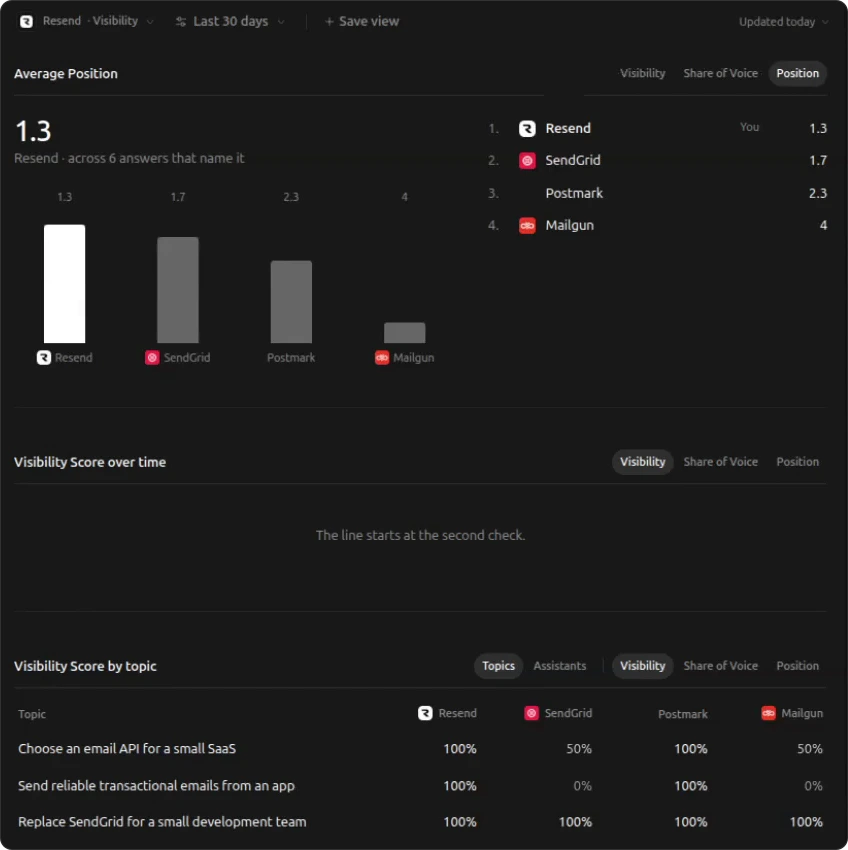
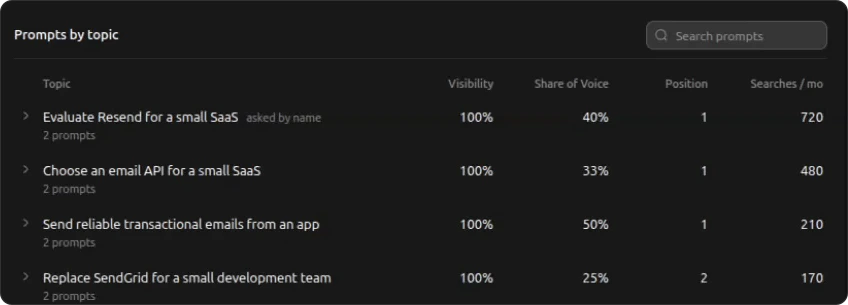
We checked Resend, an email API, against SendGrid, Postmark and Mailgun. The demo used ChatGPT with eight questions and India as the country. Two questions named Resend, so Longwave reported them separately.
Across the six remaining answers, Resend had:
- 100% visibility: ChatGPT named Resend in all six answers.
- 1.3 average position: ChatGPT placed Resend first in four answers.
- 33% share of voice: Resend received six of the 18 brand mentions.
Postmark also had 33% share of voice. SendGrid and Mailgun each had 17%.
Resend's lowest share of voice was 25%. This came from the question about replacing SendGrid for a small development team.
Questions people ask
How do I rank in ChatGPT?
Start with the questions your buyers ask. Check which products ChatGPT names and which pages it cites. Make sure AI crawlers can read your website. Write clear pages that answer those buyer questions. Longwave runs the checks and helps you identify which pages to improve.
How do I get recommended by ChatGPT?
Review the answers that name competitors but leave out your product. Check which pages ChatGPT cites in those answers. Use what you find to improve your own pages and seek mentions on relevant review or comparison pages. Run another check to see whether ChatGPT's recommendations change.
What is LLM visibility?
LLM visibility describes how often AI assistants mention your brand and where they place it in recommendations. LLM stands for large language model, the technology behind assistants such as ChatGPT and Gemini. Longwave measures your visibility, average position and share of voice across buyer questions. You can view the results by topic.
Is Longwave AI Visibility only a ChatGPT rank tracker?
No. Longwave checks both ChatGPT and Gemini. You can view each assistant's results separately or see them together. Perplexity support is coming soon.
How does Longwave help with answer engine optimization?
Answer engine optimization means improving how your product appears in AI answers. Longwave measures your mentions, rankings, share of voice and citations. Your agent reviews these results and suggests changes to your website or content.
How often does Longwave check my AI visibility?
You choose the schedule, with checks available as often as weekly. The agent suggests a schedule during setup, and you can change it. Each check takes about ten minutes. It continues even if you close the chat.
How much does the AI Visibility plugin cost?
Every Longwave account gets one free check each calendar month. It covers 25 questions on ChatGPT and Gemini for one product. The paid plan costs $5 a month and checks up to 250 questions every week. That covers 10 products with 25 questions each. You can also try the free AI visibility checker .
Do I need the Longwave app to use it?
No. You can use the plugin in ChatGPT, Codex or Longwave. Use the Longwave app when you want an agent to make changes based on your results, such as drafting a missing page.
See whether AI recommends your product
Share your product's name with the agent. Review the questions and choose a schedule. Longwave runs the checks and tracks your results.